

My wife has a saying: “Nature is beautiful, but her elements are harsh,” and as we’ve discovered after 4 years, this is a great metaphor for life in Belize.
TL;DR
Paradise has a premium: True freedom and beauty in a developing country require fighting through constant infrastructure and logistical friction.
Expect the unexpected: From remote medical emergencies to power grid failures during summer heat waves, your adaptability will be tested.
The fundamental trade-off: Moving abroad isn’t about escaping problems; it’s about trading predictable boredom for beautiful volatility.
The Stark Contrast of Moving to Belize
Moving to Belize puts you face-to-face with a heavy juxtaposition. I don’t know if “hardship” is too extreme a word, but it’s a constant push-and-pull between immense natural beauty and raw struggle. Geographically, the country is stunning—the jungle and mountains, the sea, the reef, and one of the highest concentrations of bird diversity anywhere. Additionally, the country’s cultural demographics are equally diverse. You have approximately 400,000 people split across Maya, Garifuna, Creole, Mestizo, Chinese, Lebanese, East Indian, Central American, and Western expats (and for the most part, everyone genuinely gets along).
But hiding behind that postcard is a baseline reality that will beat you up if you aren’t ready for it.
The Cost of Entry: Health Scares and Hard Friction
Our first three years here were anything but easy. When we first moved, we almost lost our youngest son to a severe bacterial infection. We’ve almost lost a cat to a poisonous plant and a dog to a toxic cane toad. We’ve had to handle a sudden machete wound to a foot on a Sunday morning when there wasn’t a single doctor around in a part of Belize that was unfamiliar. We’ve navigated head stitches; thankfully, right as the new Poly Clinic opened up here in Placencia.
And, honestly, that’s just the tip of the proverbial fucking iceberg. Beyond the medical emergencies, the logistical friction is constant:
The Immigrant Barrier: While Belizeans are highly accepting, there is still a natural cultural divide and a barrier to entry that you have to respect as a foreigner.
Supply Chain Lifelines: My wife’s art business relies heavily on shipping internationally. For a nearly six-month stretch, border and customs disruptions completely shut down her infrastructure; fuckin’ Trump! And, while things have improved immensely, the process of getting the fruit of her labour out of this country is never straightforward.
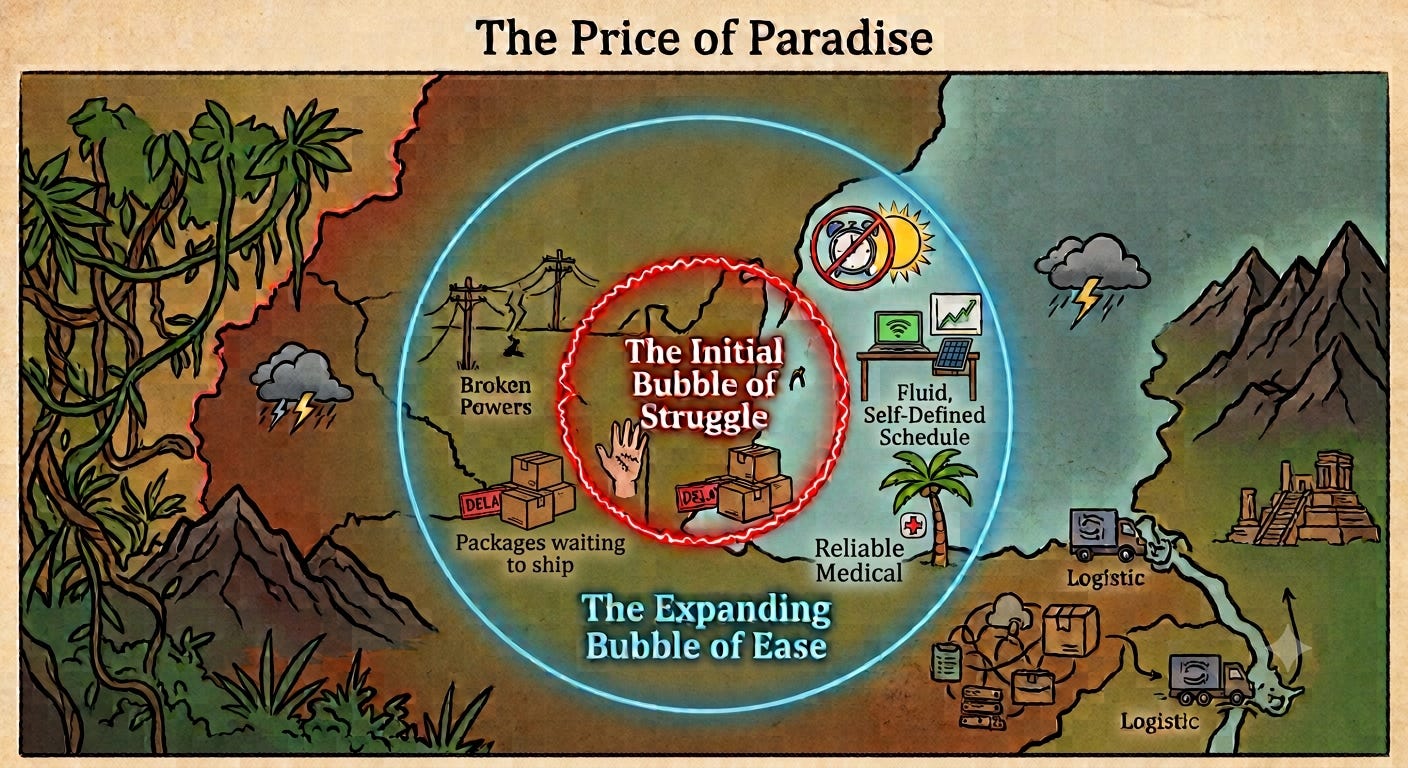
Infrastructure Strain: I run an online business. While the internet in Belize is solid, the power grid is not. During peak summer months, heat waves strain infrastructure as everyone turns on their air conditioning. The power drops right when I’m mid-call or deep in a production workflow.
But all of this is just a rite of passage.
Anyone who stays here for an extended period of time experiences some version of this.
Whether it’s a contractor running away with your hard-earned money, a loved one dying unexpectedly, your marriage falling apart, or your finances taking a nose dive. Everyone gets tested if they want to live here.
Expanding the Circumference of Ease
My wife and I were talking the other day about the freedom we’ve built here. We haven’t set an alarm in the morning in ages; and that fucking glorious! We wake up, dictate our own schedules, and that provides a level of freedom we just didn't have in Canada. We aren’t beholden to anyone. We own our land, home, and vehicle. We are truly free.
But that ease wasn’t handed to us; it was a hard-fought battle.
You have to fight to carve out a space for yourself in a developing country just to achieve a baseline of comfort. Once you survive the initial friction, you can start pushing the boundaries of your little freedom bubble and expanding the circumference of your “area of ease.” You get to know the locals. You discover where to find a long-lost essential. You gain a connection to a service provider that makes your life easier. Everything gets a bit more manageable as that bubble grows, but the harsh contrast outside of it never goes away.
Unless you are incredibly wealthy and can simply buy your way out of every inconvenience, you have to fight for your peace; yeah, I know, that sounds ironic, but it's true.
The Trade-off of a High-Beauty Life
If you are planning a move to the tropics—whether it’s the jungle, the mountains, or the beach—you need to understand this fundamental dichotomy. Some days, the hardships will make you want to pack up and leave, but then the country pulls you right back in with a moment of absolute, breathtaking beauty or peace. A morning coffee filled with bird song, or watching your kids laughing on the beach while the dogs fetch coconuts, and your wife quitely reads while the sea laps at her toes. The moments when you realize, “this is what I moved for.” They are hard-won moments, but perhaps that’s what makes them all the more special.
But, it’s a deliberate trade-off:
Do you want the predictable, monotonous, and restrictive life you had back home?
Or do you want a highly beautiful and freeing lifestyle, but with the knowledge that you must accept the extreme logistical and systemic challenges that come with the territory?
For some it’s a hard decision. For me, after 4 years here, it’s a no-brainer.
Next Step Planning
If you’re looking at making a move and need a realistic, data-backed assessment of where you actually fit, check out MoveSmart, an AI-powered relocation tool I built to cut through the sugar-coated fluff and match your real needs to the right country.
And hit me up if you want to chat about the reality of four years on the ground in Belize.